- Discovery of Very High Energy Gamma-Ray Emission from the
distant FSRQ PKS 1441+25 with the MAGIC telescopes: This source
is the second distant VHE gamma-ray source with the redshift of
0.939 (Shaw et al. 2012, ApJ, 748, 49). It is discovered by
MAGIC on April 20, 2015. MAGIC is a system of two 17m-diameter
Imaging Atmospheric Cherenkov Telescopes designed to perform
gamma-ray astronomy in the energy range from 50 GeV to greater
than 50 TeV. The flux above 80 GeV is estimated to be about
8e-11 cm^-2 s^-1 (16% of Crab Nebula flux). Preliminary analysis
show detection significant of 6 standard deviations during ~2
hours observation in the night between 17 and 18 of April; and
11 standard deviations during ~4 hours observations in the night
between 18 and 19 of April (http://www.astronomerstelegram.org/?read=7416
). The highest optical R-band magnitude is 15.6 and was measured
in the night between 21 and 22 April using KVA telescope
(http://users.utu.fi/kani/1m/PKS_1441+25.html ).
- MAGIC detects an increased activity from FSRQ PKS 1510-089 at very high energy gamma-rays: The redshift of this source is 0.36. The preliminary analysis shows a highly significant signal and a flux of ~20% from that of the Crab nebula above 100 GeV for the data taken from 2015/05/18 to 2015/05/19. This implies an increase by a factor of ~5 with respect to the flux reported previously in 2012. The source is active now in Optical and IR-band as well (http://www.astronomerstelegram.org/?read=7542 ). We are performing optical monitoring in R-band using KVA telescope. The current flare in Optical is the second one after 6 years since the monitoring of this source started in the Tuorla blazar monitoring program (http://users.utu.fi/kani/1m/PKS_1510-089.html )
Showing posts with label Cherenkov technique. Show all posts
Showing posts with label Cherenkov technique. Show all posts
Thursday, May 21, 2015
Newest blazar discoveries in VHE gamma-rays band
Saturday, April 20, 2013
Imaging Air Cherenkov Technique (IACT)
The detection of very high energy gamma rays is based on the imaging air Cherenkov technique.
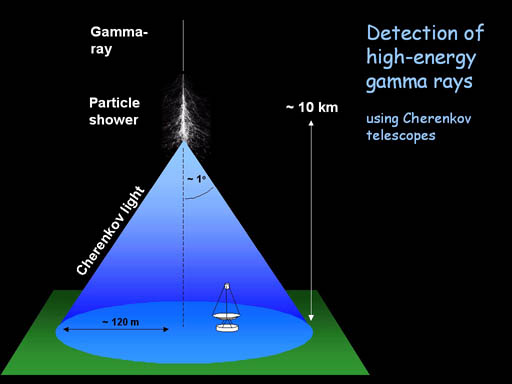
An incident high-energy gamma ray interacts high up in the atmosphere and generates an air shower of secondary particles. The number of shower particles reaches a maximum at about 10 km height, and the shower dies out deeper in the atmosphere. Since the shower particles move at essentially the speed of light, they emit Cherenkov light, a faint blue light.
An incident high-energy gamma ray interacts high up in the atmosphere and generates an air shower of secondary particles. The number of shower particles reaches a maximum at about 10 km height, and the shower dies out deeper in the atmosphere. Since the shower particles move at essentially the speed of light, they emit Cherenkov light, a faint blue light.
The Cherenkov light is beamed around the direction of the incident primary particle and illuminates on the ground an area of about 250 m diameter, often referred to as the Cherenkov light pool. For a primary photon at TeV energy (1012 eV), only about 100 photons per m2 are seen on the ground. They arrive within a very short time interval, a few nanoseconds.
A telescope located somewhere within the light pool (Figure 1) will "see" the air shower, provided that its mirror area is large enough to collect enough photons. The "effective detection area" of a Cherenkov telescope is therefore given roughly by the area of the Cherenkov light pool, about 50000 m2, to be compared with the sub-m2 detection area of satellite instruments aiming to detect gamma rays before they interact with the atmosphere.
 |
| Figure 1 |
The image obtained with the telescope shows the track of the air shower, which points back to the celestial object where there incident gamma ray originated. The intensity of the image is related to the energy of the gamma ray. The shape of the image can be used to reject unwanted "background", such as showers induced by cosmic ray particles.
With a single telescope providing a single view of a shower, it is difficult to reconstruct the exact geometry of the air shower in space. The achieve this, multiple telescopes are used which view the shower from different points and allow a stereoscopic reconstruction of the shower geometry. [2]
MAGIC, HESS and VERITAS are current generation of pointing telescopes which use IACT to observe VHE gamma-ray of the different sources.
Next generation of these telescope would be Cherenkov Telescope Array (CTA) which is planned to start operation in 2016.
Subscribe to:
Posts (Atom)