Showing posts with label MAGIC. Show all posts

Monday, July 27, 2015

Discovery of VHE Gamma-Ray Emission from the BL Lac S2 0109+22

I am very happy to announce this discovery as the first discovery that i was involved in.

The MAGIC collaboration reports the discovery of very high energy (VHE; E>100 GeV) gamma-ray emission from the BL Lac S2 0109+22 (z=0.265 RA: 01h12m05.8s Dec:+22d44m39s, J2000). The object was observed with the MAGIC telescopes for 5.3 hours from 2015/07/22 to 2015/07/25. The preliminary analysis of the first three nights of MAGIC data showed an excess with a statistical significance of ~5 standard deviations. The VHE flux of this detection was estimated to be (1.6+/-0.7)e-11 ph/cm2/s above 100 GeV, about 3% of the flux from the Crab nebula. The daily flux shows a marked enhancement on the night of 25 July up to (9.7+/-1.5)e-11 ph/cm^2/s, ~15% of the Crab flux at E>100 GeV, corresponding to an excess with >7 sigma statistical significance. S2 0109+22 is classified as an intermediate-synchrotron peaked BL Lac object. The multi-year optical and radio historical coverage showed optical variations with typical timescales from weeks to months.

See more:
http://www.astronomerstelegram.org/?read=7844  
Friday, June 19, 2015

BL Lacertae activity at VHE gamma-rays

The MAGIC telescopes have detected Very High Energy gamma-ray flux from BL Lacertae. The preliminary analysis indicates a highly significant signal above 200 GeV. The emission is variable, with a flux of 0.4 and 0.1 times the flux of the Crab nebula above 200 GeV in the nights 14/15 and 16/17, respectively. The flux level is similar to the flaring state reported in Arlen et al. 2013. The observations were triggered by the high activity measured at optical and gamma-ray energies. X-ray ToO observations with the Swift satellite did not show any substantial enhancement in the X-ray flux.
For more information see: http://www.astronomerstelegram.org/?read=7660

Thursday, May 21, 2015

Newest blazar discoveries in VHE gamma-rays band

  1. Discovery of Very High Energy Gamma-Ray Emission from the distant FSRQ PKS 1441+25 with the MAGIC telescopes: This source is the second distant VHE gamma-ray source with the redshift of 0.939 (Shaw et al. 2012, ApJ, 748, 49). It is discovered by MAGIC on April 20, 2015. MAGIC is a system of two 17m-diameter Imaging Atmospheric Cherenkov Telescopes designed to perform gamma-ray astronomy in the energy range from 50 GeV to greater than 50 TeV. The flux above 80 GeV is estimated to be about 8e-11 cm^-2 s^-1 (16% of Crab Nebula flux). Preliminary analysis show detection significant of 6 standard deviations during ~2 hours observation in the night between 17 and 18 of April; and 11 standard deviations during ~4 hours observations in the night between 18 and 19 of April (http://www.astronomerstelegram.org/?read=7416 ). The highest optical R-band magnitude is 15.6 and was measured in the night between 21 and 22 April using KVA telescope (http://users.utu.fi/kani/1m/PKS_1441+25.html ).
  2. MAGIC detects an increased activity from FSRQ PKS 1510-089 at very high energy gamma-rays: The redshift of this source is 0.36. The preliminary analysis shows a highly significant signal and a flux of ~20% from that of the Crab nebula above 100 GeV for the data taken from 2015/05/18 to 2015/05/19. This implies an increase by a factor of ~5 with respect to the flux reported previously in 2012. The source is active now in Optical and IR-band as well (http://www.astronomerstelegram.org/?read=7542 ). We are performing optical monitoring in R-band using KVA telescope. The current flare in Optical is the second one after 6 years since the monitoring of this source started in the Tuorla blazar monitoring program (http://users.utu.fi/kani/1m/PKS_1510-089.html )

Monday, September 15, 2014

Farthest ever detected TeV source (blazar: S3 0218+357)

Gravitationally lensed blazar S3 0218+357 was discovered in TeV band by MAGIC telescope in July 2014. MAGIC observed the source for 3.5 hours during the period of July 23 and July 26, 2014. Preliminary analysis of data resulted in detection of the source with a statistical significant of more than 5 standard deviations. This source is located at the redshift of 0.944. The measured flux is about 15% of Crab flux in the range of 100-200 GeV.

More information in:
http://www.astronomerstelegram.org/?read=6349

Thursday, May 23, 2013

VHE Gamma-Ray Emission from H1722+119

H1722+119 is a BL Lac object, that was listed as candidate TeV blazar in Costamante & Ghisellini (2002) based on its X-ray and radio properties. Its redshift is uncertain; Sbarufatti et al. 2006 give z>0.17. The source has been detected by Fermi-LAT, in the Second Fermi Catalogue with F(>1 GeV) (3.7+-0.3)e-09 cm^-2 s^-1 and with spectral index 1.92+-0.06.
H1722+119 was observed for five nights by the MAGIC telescopes starting May 17th 2013 and collecting 11 hours of good quality data. A preliminary analysis yields a detection of the source with a statistical significance of more than 5 standard deviations. The VHE flux of this detection is about 2% of the flux from the Crab nebula above 140 GeV. The previous VHE gamma-ray observations of the source produced an upper limit of 4.2% Crab nebula flux above 140 GeV (Aleksic et al. 2011).
The MAGIC observations were triggered by the extended optical high state of the source, reported by the Tuorla blazar monitoring program (http://users.utu.fi/kani/1m). At the beginning of May 2013 the source reached an R-band magnitude of 14.65, the brightest ever observed since 2005, when the monitoring started. We also analyzed the Fermi-LAT data, finding indication of a spectral index harder than reported in the Second Fermi Catalog. A Swift-XRT ToO observation was performed on 20th May.
MAGIC will continue the observations of the source as soon as the moon conditions allow it again and multiwavelength observations are encouraged.
The MAGIC contact persons for these observations are J. Cortina (cortina@ifae.es) and E. Lindfors (elilin@utu.fi).
MAGIC is a system of two 17m-diameter Imaging Atmospheric Cherenkov Telescopes located at the Canary island of La Palma, Spain, and designed to perform gamma-ray astronomy in the energy range from 50 GeV to greater than 20 TeV. 

http://www.astronomerstelegram.org/?read=5080

Sunday, May 12, 2013

VHE Gamma-Ray Emission from MS1221.8+2452

The MAGIC collaboration reports the discovery of very high energy (VHE; E>100 GeV) gamma-ray emission from MS1221.8+2452 (12h24m24.2s +24d36m24s, J2000.0). MS1221.8+2452 is a blazar located at a redshift of 0.218 (Sbarufatti et al., 2005, ApJ 635, 173) and classified as a high synchrotron peaked (HSP) BL Lac. It is one of the very few BL Lacs that has been imaged with the Hubble Space Telescope (Jannuzzi et al., 1997, ApJ 491, 146). It has been included in the ROSAT Bright Source Catalog (Voges et al., 1999, A&A 349, 389) and identified as XBL (X-Ray-Selected BL Lac) by the Einstein Extended Medium Sensitivity Survey (Rector et al. 2000, AJ 120, 1626). 
The object was observed with the MAGIC telescopes for 4 hours from 2013/04/30 to 2013/05/01. The preliminary analysis of these data resulted in the detection of MS1221.8+2452 with a statistical significance of more than 5 standard deviations. The VHE flux of this detection was estimated to be about 4% of the Crab nebula flux above 200 GeV.
MS1221.8+2452 was observed with Swift during March and April 2013, showing flux variability ranging from 3e-12 erg/cm2/s to 13e-12 erg/cm2/s in the 0.3-10 keV energy range. This source was flagged as a promising VHE source candidate by the Fermi-LAT collaboration, information that was shared with the MAGIC collaboration (as well as other ground-based gamma-ray instruments).
MAGIC observations on MS1221.8+2452 will continue during the next days until 2013/05/12 and multiwavelength observations are encouraged.
The MAGIC contact persons for these observations are J. Cortina (cortina@ifae.es) and F. Borracci (frabor@mpp.mpg.de).
MAGIC is a system of two 17m-diameter Imaging Atmospheric Cherenkov Telescopes located at the Canary island of La Palma, Spain, and designed to perform gamma-ray astronomy in the energy range from 50 GeV to greater than 20 TeV. 

Saturday, April 20, 2013

Imaging Air Cherenkov Technique (IACT)

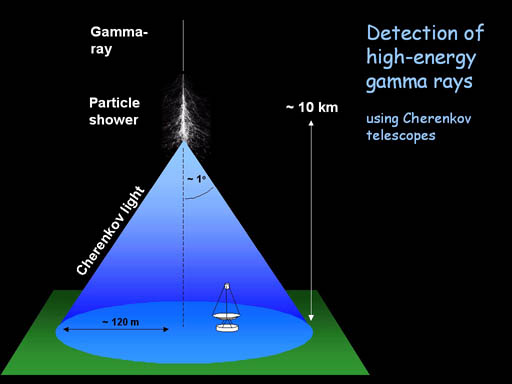
The detection of very high energy gamma rays is based on the imaging air Cherenkov technique.
An incident high-energy gamma ray interacts high up in the atmosphere and generates an air shower of secondary particles. The number of shower particles reaches a maximum at about 10 km height, and the shower dies out deeper in the atmosphere. Since the shower particles move at essentially the speed of light, they emit Cherenkov light, a faint blue light. 
The Cherenkov light is beamed around the direction of the incident primary particle and illuminates on the ground an area of about 250 m diameter, often referred to as the Cherenkov light pool. For a primary photon at TeV energy (1012 eV), only about 100 photons per m2 are seen on the ground. They arrive within a very short time interval, a few nanoseconds.
A telescope located somewhere within the light pool (Figure 1) will "see" the air shower, provided that its mirror area is large enough to collect enough photons. The "effective detection area" of a Cherenkov telescope is therefore given roughly by the area of the Cherenkov light pool, about 50000 m2, to be compared with the sub-m2 detection area of satellite instruments aiming to detect gamma rays before they interact with the atmosphere.
 
Figure 1
The image obtained with the telescope shows the track of the air shower, which points back to the celestial object where there incident gamma ray originated. The intensity of the image is related to the energy of the gamma ray. The shape of the image can be used to reject unwanted "background", such as showers induced by cosmic ray particles.
With a single telescope providing a single view of a shower, it is difficult to reconstruct the exact geometry of the air shower in space. The achieve this, multiple telescopes are used which view the shower from different points and allow a stereoscopic reconstruction of the shower geometry. [2]
MAGIC, HESS and VERITAS are current generation of pointing telescopes which use IACT to observe VHE gamma-ray of the different sources.
Next generation of these telescope would be Cherenkov Telescope Array (CTA) which is planned to start operation in 2016.